
Legislative Update: Senate Ag Committee acts on policy bill
Just a day away from a weekslong legislative break, lawmakers at the state Capitol are holding packed hearings to consider priority bills ahead of legislative deadline on Friday, March 27. As always, MFU has been active at the Capitol, ensuring that our voice is heard on our grassroots priority issues. Just in the first part of this week, members and staff provided formal testimony on 14 pieces of legislation covering everything from local news to managed grazing.
Thank you to members who’ve made time to testify. I hope others will find opportunities to connect with lawmakers over break. You can find out who represents you and how to contact them by entering your address here.
This week in the Minnesota Senate, Agriculture Committee Chair Aric Putnam, DFL-SD14, took action on an amended policy omnibus bill and considered a slate of funding bills, including many MFU has been working to advance.
His policy omnibus (SF4561) was unanimously passed out of committee on Wednesday after an efficient consideration and adoption of bipartisan amendments.
“This committee works well together,” Chair Putnam said in closing his last hearing before break. “That’s why today went as efficiently as it did because we talk with each other, and work together, and keep focusing on what needs to be done.”
This sort of cooperation is not found in all jurisdictions and could prove central to getting a final deal on agriculture done this year. As a reminder, Minnesota budgets on biannual basis and there’s no constitutional or other requirement for lawmakers to make changes to policy or budgets in 2026.
The policy omnibus largely included non-controversial items brought forward by the Minnesota Department of Agriculture. That said, there were some key provisions for which MFU shared support.
First, the bill would create a first, clear, statutory definition of ‘agrivoltaics’—the practice of engaging in production agriculture under or alongside solar panels.
“We have members who are building their enterprises based on this model,” said MFU President Gary Wertish in written comments to the committee. “We appreciate MDA’s work to provide a clear definition and believe this will help this emerging industry continue to develop in a way that benefits farmers.”
Wertish also shared support for provisions that would help clarify expanded scope of practice for Licensed Veterinary Technicians.
“Particularly in the face of damaging new animal diseases, now is the time to ensure that farmers, county fairs, livestock auctions, and others have the professional help they need to ensure the health of livestock,” he wrote, making the case for changes ushered through by Senate Agriculture Vice Chair Rob Kupec, DFL-SD4.
In addition, Wertish made the case for provisions requiring clear and accurate labeling of cell-cultured meat, writing that “clear, informative labeling will help consumers make informed decisions and ensure a level playing field.”
“[We] believe strongly that livestock bring important benefits to our communities and economies. Consumers should have the right to choose to support the work of Minnesota farmers and ranchers,” he continued. This change was brought forward by Sen. Rich Draheim, R-SD22.
On the budget side, the Senate Agriculture Committee also heard proposals that will be considered for a potential agriculture spending bill.
First, Mary Metelak, a MFU member—and co-owner and business manager of Benson + Turner Meats in Waubun—testified in support of Sen. Mary Kunesh’s, DFL–SD39, bill to increase funding for Minnesota’s Local Food Purchase Assistance (LFPA) program (SF3864), dubbed the Farm to Food Security Grant Program. Applications for new projects are due at 4 p.m., March 31.
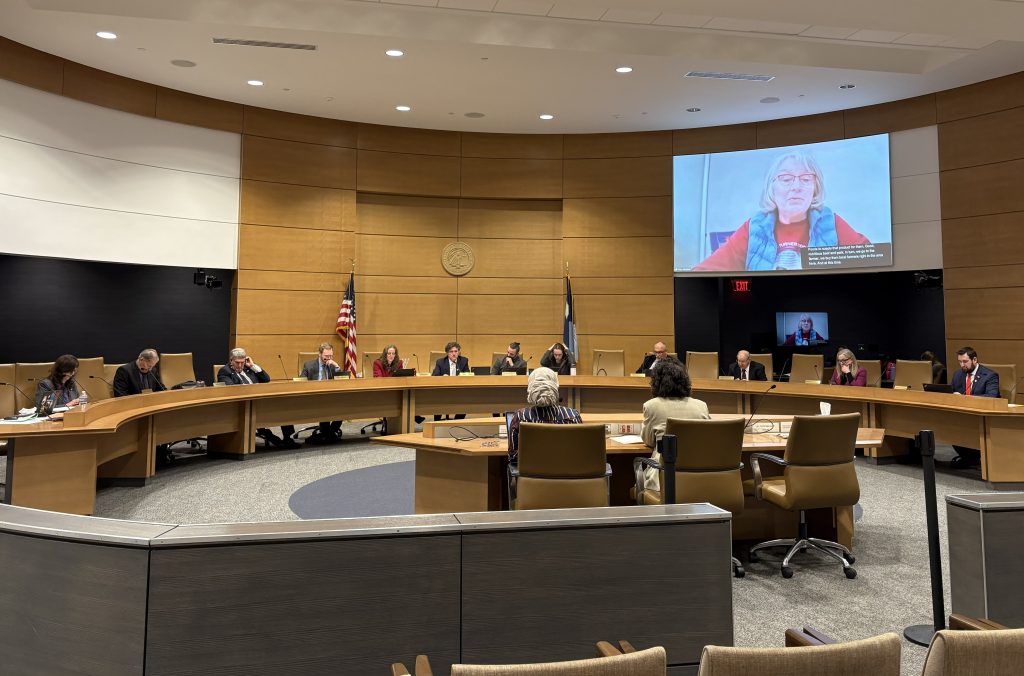
Mary Metelak, co-owner and business manager of Benson + Turner Meats in Waubun, testified in support of Sen. Mary Kunesh’s bill to increase funding for the Local Food Purchase Assistance program in the Senate Agriculture Committee.
Metelak highlighted how LFPA funding supports multiple parts of the local food system.
“The Red Lake Indian Reservation’s Agriculture Department and the White Earth Food Shelf have received funding and partnered with us to supply nutritious beef and pork,” she said. “We then purchase from over 18 local farmers—many of them emerging producers.”
Metelak also highlighted the jobs their business has created, noting that “employing people within our own community helps strengthen our economic viability.”
After federal LFPA funding was cut by more than $3 million in 2025, Minnesota established a state program funded at $700,000 annually—far below the nearly $5 million requested in 2024. Increased funding would help meet demand and expand market access for beginning and underserved farmers, while improving access to healthy food for communities across the state.
Second, Sam Birkholz, owner of Pleasant Valley Orchard in Shafer, Minn., testified in support of Sen. Heather Gustafson‘s, DFL-SD36, bill to increase funding for the Minnesota Grown program from $186,000 to $261,000, expanding access to marketing tools and resources for local producers (SF4066). Birkholz direct markets apples, pumpkins and berries, and serves on both the Minnesota Apple Growers Association and the Minnesota Grown Advisory Board.
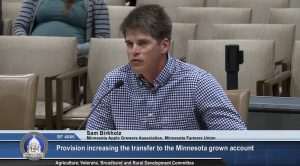
Sam Birkholz, co-owner of Pleasant Valley Orchard in Shafer, testified in support of Sen. Heather Gustafson’s bill to increase funding for the Minnesota Grown program.
“We’re a very traditional orchard—we don’t have a lot of bells and whistles,” Birkholz said. “While we offer some agritourism through tours and small events, our focus is on growing high-quality fruit.”
He noted that during the fall season, Minnesota apple growers face stiff competition from apples grown and shipped in from states like Washington and Michigan, often at lower prices.
“It can be difficult to secure and defend space on the produce shelf,” he said. “That’s where the Minnesota Grown program comes in. Their trusted brand helps consumers quickly identify our product and choose to support a local business.”
Birkholz emphasized that the program provides valuable marketing support, including participation in a directory reaching more than 400,000 people annually, access to promotional materials such as seasonal apple variety guides, statewide media campaigns, and cost-share opportunities for marketing.
“Participation has grown by over 40 percent since 2007, but funding has remained stagnant,” Birkholz said. “We know consumers value locally grown food. This investment adds value to small family farms like ours, and I hope it earns your support.”
Third, Melany Thomas, a certified organic producer in Clay County, testified in support of Senator Kupec’s bill directing the Minnesota Department of Agriculture to study land ownership trends in the state (SF2431).
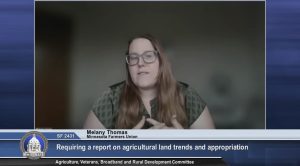
Melany Thomas, a certified organic producer in Clay County, testified in support of Sen. Robert Kupec’s bill directing the Minnesota Department of Agriculture to study land ownership trends in the state.
Thomas expressed concern about rising farmland prices and increasing competition from out-of-state investors. “We’re competing against buyers who have teams dedicated to purchasing farmland because it offers, quote, better returns than the stock market,” she said.
While the bill does not propose a specific solution, Thomas emphasized the importance of better data. “I hope it provides meaningful insights into what’s driving up land costs and helps strengthen existing programs like the Beginning Farmer Tax Credit (BFTC), the Down Payment Assistance (DPA) program, and others.”
The report would offer a more comprehensive view of how these programs are working, while also shedding light on the factors driving up farmland costs for farmers. The bill which MFU has worked to advance for a number of years now also earned the support of the Minnesota Corn Growers Association (MCGA) and Land Stewardship Project (LSP).
Finally, for budget related items, MFU staff testified in support of the Chair Putnam’s bill to update Minnesota’s Farm Down Payment Assistance Program (SF4586).
Putnam, noted that “since its creation in 2023, 439 people have applied, and 112 have been able to use this benefit to start a life in agriculture and contribute to their communities and local economies.”
The rate of denials for this popular and powerful program is made more concerning by that $800,000—a majority—of the funding made available to the program last year was returned to the general fund after farmers were not able to close a land deal before funding expired.
Putnam’s bill would extend the timeline for using grants and add some basic readiness requirements for applicants.
“The promise of agriculture is the ability to invest in land, build equity, and create long-term stability. Ownership allows farmers to invest in infrastructure, soil health, and their communities,” said MFU Government Relations Director Stu Lourey in testimony.
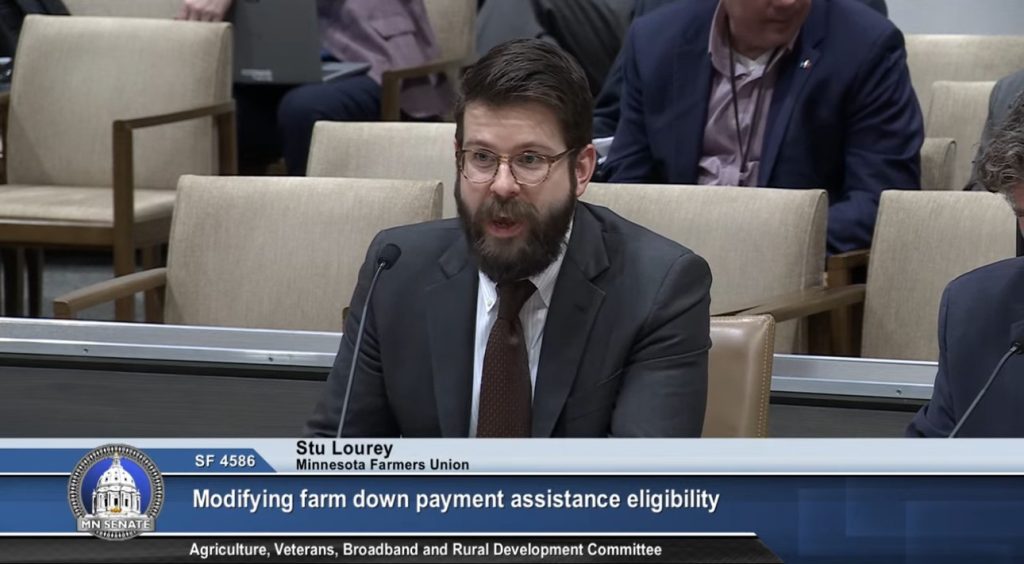
Stu Lourey, MFU Director of Government Relations, testified in support of Chair Aric Putnam’s bill to modify eligibility requirements for the Farm Down Payment Assistance program.
He added that with limited funding and a lottery-based system, ensuring funds are fully utilized is critical.
“The most important thing is that the funding you all fought for and secured last session goes out to support new farmers. That means more basic readiness requirements and extended timelines to make sure everyone can use the program.”
In the House Agriculture Committee
In the House, the Agriculture Committee also revisited co-Chair Paul Anderson’s, R-HD12A, bill to make changes to the Down Payment Assistance Program (HF3548) and adopted an amendment with changes negotiated by Rep. Samantha Vang, DFL-HD38B. In her time as Agriculture Chair, Rep. Vang championed the creation and funding of Minnesota’s farm down payment assistance program, modeling it after similar programs in housing. This demonstration of constructive bipartisan work is all progress toward on a potential final deal.
They also heard Rep. Vang’s bill to extend funding for meat processing workforce development (HF4372), an initiative MFU worked hard to create in 2023.
The Meat Processing Train and Retain Grant program provides funding to partner organizations to help small- and mid-sized meat and poultry processors recruit, hire, and train new employees.
“This work is critical to address the shortage of meat processing in our state—and to create new opportunities for more people in agriculture,” said Vang.
Lourey emphasized that the program builds on broader efforts to support local and regional processors.
“During the pandemic, we all saw what Farmers Union members have long understood: when just four multinational companies control most of the meat processing industry, the system becomes brittle, prone to disruption, and doesn’t serve workers, consumers, or farmers particularly well,” he said.
Grant funds can be used for a range of workforce-related expenses, including tuition reimbursement, signing and retention bonuses, and employee relocation costs. The program has already supported training opportunities for students studying meat cutting at Central Lakes College in Staples and Ridgewater College in Willmar.
Rep. Nathan Nelson, R-HD11B also voiced support for the bill.
“Many of us remember when nearly every town had a locker plant,” he said. “That generational knowledge has been lost over time. When I talk to plant owners, one of their biggest challenges is finding skilled workers with meat cutting experience. There’s definitely a desire to get back into that but training is much needed.”
Grazing bill heard
On Monday, the House also heard Nelson’s bill to establish a Rotational Grazing Pilot program (HF4388), the same led by Sen. Torrey Westrom, R-SD12, in the Senate.
Hannah Bernhardt, a regenerative livestock producer in Pine County, testified alongside her son, Harvey.
“Regenerative grazing practices benefit soil health, wildlife habitat, water quality, and animal welfare,” Bernhardt said. She emphasized that the program would help more farmers adopt these practices.
“This program would support our farm and help more of my neighbors transition to rotational grazing—providing public benefits while also making farm businesses more resilient economically and in the face of extreme weather.”
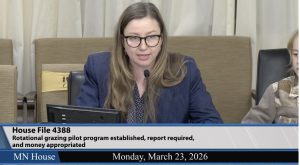
Hannah Bernhardt, a regenerative livestock producer in Pine County, testified in support of Rep. Nathan Nelson’s bill to establish a rotational grazing pilot program.
Bernhardt noted that while effective, these systems can be costly to implement. Establishing rotational grazing often requires pasture design, fencing, watering systems, shelter, and perennial plantings, along with additional time, education, and management.
“When I started my farm, I could only afford raw land and had to make significant investments in fencing,” she said. “Cost-share support can be invaluable in getting over that initial financial hurdle.”
She added that, over time, these practices can pay for themselves by increasing forage production, reducing feed costs, and improving land carrying capacity so farmers can feed more people in the future.
Ultimately, House Agriculture Committee Co-Chair Rick Hansen, DFL-53B, objected that the bill was funded out of Legislative-Citizen Commission on Minnesota Resources (LCCMR) fund and recommended a no vote on those grounds. With a tie vote, the bill failed to advance.
That said, work on this idea will certainly continue. As Bernhardt noted in her testimony, MFU worked with MDA to submit a funding proposal on rotational grazing directly to LCCMR so it can be considered through the regular process.
Another bill that failed to advance due to a tied vote was the DAIRI program eligibility bill. DFLers on the House Ways and Means Committee voted against Nelson’s legislation to clarify eligibility for the Dairy Assistance, Investment, Relief Initiative (DAIRI) program (HF3508) ensuring that new farmers can benefit from the program. This is the same bill that Kupec led to unanimous approval in the Senate just a week earlier.
The bill failed despite supportive testimony from Agriculture Commissioner Thom Petersen, when he was called up House Ways and Means Chair Paul Torkelson, R-HD15B.
“I really would appreciate if we could move this bill, because we’d like to get these dollars out to our dairy farmers as soon as possible.”
House Ways and Means Co-Chair Cedrick Fraizer, DFL-HD43A, thanked Nelson for his work and said he was “looking forward to helping these farmers.” With that and citing questions from members of their caucus he recommended a ‘no’ vote from DFLers on committee.
“We’re gonna get this done,” he continued, “but today we’re not going to vote to move it on.”
The bill was laid over, pending further action by the House Ways and Means Committee. MFU will continue making the case for acting quickly.
Farmer-Lender Mediation
A bill that did receive a vote in a House Committee was Smith’s bill (HF3692) to extend Minnesota’s Farmer-Lender Mediation program, which the House Agriculture Committee approved unanimously on Wednesday. The bill was referred to the Higher Education Committee and technically still needs to be heard in the Judiciary Committee before Friday’s deadline.
That said, a vote in the Agriculture Committee is an important step. Furthermore, the bill cleared all the necessary committees in the Senate long before deadline after Putnam made it his top priority, moving it forward during his first committee hearing.
Of course, this is just a snapshot of our legislative work at the State Capitol. If you have thoughts, questions, ideas, or concerns about MFU’s work at the legislature, please reach out to stu@mfu.org or (320) 232-3047.