
Legislative Update: Bonding bill undone as adjournment date nears
While the U.S. House is advancing a so-called ’skinny’ farm bill, Minnesota lawmakers are heading quickly toward a final deadline to complete their legislative work for 2026. MFU continues to work hard at the Capitol. If you’re curious about MFU’s work throughout the session, you can find our past articles at mfu.org/legislation.
DAIRI bill signed
To start, two important items MFU supported have now been signed into law by the governor.
First, Gov. Tim Walz signed Sen. Rob Kupec, DFL-SD4, and Rep. Nathan Nelson’s, R-11B, bill to allow new farmers to participate in Minnesota’s Dairy Assistance, Investment, Relief Initiative (DAIRI) (SF3832; Session Law 54). Applications closed on April 9, but this law will ensure that new farmers who applied will still be eligible.
Second, technical fixes for Minnesota’s Veterinary Technician licensing (HF3718; Session Law 53) became law with the governor’s signature, ensuring the expanded scope of practice functions properly for veterinarians and farmers across the state.
While these are relatively small, largely uncontroversial updates to current policy, it is meaningful to see action and important for the functioning of these programs. So far this year, the governor has signed 21 bills into law.
When it comes to larger items, it’s important to remember Minnesota passed a two-year budget last session, so the government will not shut down if lawmakers fail to come together around a deal on new spending or updates to policy on agriculture or any other jurisdiction. That said, legislative leaders and the governor have identified a short list of bipartisan, ‘must-do’ priorities that are likely to be part of a final deal (or all of it).
On the short list
A short list includes:
A fix to save Hennepin County Medical Center (HCMC), which serves as the state’s largest public safety-net hospital and a level-one trauma center for patients across the Upper Midwest. While the future of a metro-based healthcare systems might not seem like it could effect people in rural parts of our state, the system is where people with complex injuries are transferred for care.
At MFU’s People’s Town Hall in Willmar, a flight nurse spoke about her work to fly people with urgent injuries from rural areas for care at HCMC. Another at the Town Hall in Kittson County talked about how HCMC saved a family members’ life after they were flown to the hospital following a farm accident.
County IT modernization comes in response to new federal requirements for verifying eligibility for SNAP, Medicaid and other programs. That said, outdated software—which hasn’t been updated since the era of the computer game Oregon Trail—has long put added stress and expense on already cash strapped counties.
As many county commissioners have pointed out in the last year, new requirements and expenses pushed onto counties by the federal One Big Beautiful Bill Act passed last July leave them with little choice but to raise property taxes. The legislature has also been debating measures to help lower property taxes, including a House DFL proposal to create a new fifth tax tier and pass new revenue onto local governments.
Beyond these, legislative leaders from both parties are committed to passing new measures to continue to combat fraud in state programs and pass a bonding bill to fund capital improvements to public infrastructure.
Importantly, a bonding bill is the most likely path for renewed funding for Minnesota’s Rural Finance Authority (RFA), which offers low-interest loans to farmers facing financial distress, beginning farmers, and others. MFU President Gary Wertish and Executive Committee Chair Carol Anderson both serve on the RFA Board.
In addition to work on the RFA, we’ve also shared support for bonding dollars to upgrade the University of Minnesota’s St. Paul campus.
“Our entire agricultural economy benefits from a strong, public land-grant university that can attract and retain students who are passionate about careers in these fields,” Wertish wrote in a letter to lawmakers.
If you have any questions on a local bonding project, a local sales tax extension, or another issue, please reach out to the MFU team. We’re happy to track down that information and give you the latest.
Senate tax bill released
On April 28, Senate Tax Chair Anne Rest, DFL-SD43, released her tax bill, which prioritized a number of agriculture provisions, including Senate Ag Chair Aric Putnam’s, DFL-SD14, proposal to lift the cap on Minnesota’s Beginning Farmer Tax Credit, so that no farmer is turned away due to lack of funding.
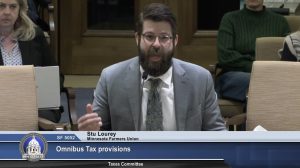
MFU Government Relations Director Stu Lourey testified before the Senate Tax Committee in support of lifting the cap on funding available for the Beginning Farmer Tax Credit (BFTC).
“[This has] been a top priority [for Farmers Union] the last two sessions, and we so value Sen. Putnam and Chair Rest, your work on this,” MFU Government Relations Director Stu Lourey said, noting the coalition of more than 20 organizations that signed onto a letter MFU led in support of the credit.
Lourey also referenced Darrell Larson who was written up in KARE 11 for selling his fourth generation farm to new farmers, Devon and Avery. He did this believing he’d be able to rely on the credit, only to find out later that he was denied to due to lack of funding.
“The promise of this credit is that beginning farmers are able to go to landowners and able to go to existing farmers, to landowners and negotiate land deals . . . This change will allow beginning farmers to know that they can rely on that credit,” Lourey told the committee.
He also pointed to Minnesota’s unique position nationally. In the 2022 Ag Census, the state saw an increase in beginning farmers, bucking broader national trends.
“We are an outlier because of forward-looking policies in our state,” he said. “I hope we continue to build on that progress.”
Chair Rest’s Tax Bill passed out of committee on April 30 and is awaiting a companion in the House. She also included a fix that MFU member Debbie Morrison testified on just last week. The bill (SF5139), is led by Sen. Jason Rarick, R-SD11, and would ensure that farm wineries can maintain their agriculture property tax designation.
Chair Rest’s bill would also expand the definition of qualifying relatives for Agriculture Homestead to include grandkids, step-kids, and nieces and nephews (SF245, Weber) and expand where retired farmers can live to maintain their Special Agriculture Homestead designation (SF2772, Rasmussen).
Finally and importantly for MFU, the bill expands aid for Minnesota’s Soil and Water Conservation Districts (SWCDs). If you’d like to see what your county would receive under the bill, you can find that here.
Riverview hearing
Outside of the legislature, MFU staff and members joined a standing-room-only crowd at the Minnesota Pollution Control Agency’s (MPCA) public hearing on Riverview’s proposal to expand their West River Dairy facility from 7,855 to 18,885 cows, making it by far the largest dairy in the state. While not technically the opportunity to provide comment, MFU Vice President Anne Schwagerl did share concerns via a question.
“What happens when something goes wrong?” she asked MPCA staff who were answering questions about the permit. “Is there an any plan or provision for a mass [mortality] event?”
The MPCA replied that in the permit, Riverview outlined their plans to work with the Board of Animal Health (BAH) and others.
At the time, MPCA said they had received nearly 1,000 public comments. You can find a link to submit formal public comments here.
At the legislature, MFU has worked to pass a proposal requiring an EIS for livestock projects over 10,000 animal units. Beyond environmental concerns, the bill (HF3490), authored by Rep. Kristi Pursell, DFL-58A, would require an analysis of the economic and social consequences of the project.
As always, this is just a snapshot of MFU’s legislative work and developments at the Capitol. If you have questions, comments, or concerns, please reach out to Stu at (320) 232-3047 or stu@mfu.org.