
Legislative Update: DAIRI bill moves ahead
Now over a week from our annual Lobby Day drive-in and just weeks from the legislative deadline to hear new bills, Minnesota Farmers Union (MFU) staff and members have been busy testifying on priority legislation at the Capitol. This all while leadership and delegates represent Minnesota members at National Farmers Union (NFU) convention in New Orleans.
Early Thursday morning, a final committee approved Sen. Rob Kupec’s, DFL-Moorhead, bill to fix the Dairy Assistance, Investment, Relief Initiative (DAIRI) and allow new farmers to participate (SF3832).
“With support from our members and others, DAIRI was renewed in 2023. Unfortunately, the federal program DAIRI leverages was not renewed until last year. Today, dairy farmers are again in need of support, and this fix is needed to ensure that the newest farmers can participate,” wrote MFU President Gary Wertish in a letter to committee members.
The DAIRI program is intended to reimburse farmers for enrolling in federal risk protection through the Dairy Margin Coverage (DMC) program. The $3 million available to the program will be paid out to eligible dairy farmers on a prorated basis based on the number of applicants.
“We appreciate that this program is targeted toward family-sized dairies . . . [and] we value that this will help farmers get the most from federal programs,” President Wertish continued in his letter.
A second Senate bill was sent to the general register from the Senate Agriculture Committee the evening before. This means that—like the DAIRI fix—it could be voted on by the full Senate as a standalone bill.
This bill (SF239), brought and amended by Sen. Rich Draheim, R-Madison Lake, would define and require labeling of lab-grown cell-cultured food. Supported by livestock organizations, including Minnesota Farmers Union (MFU), is intended to ensure that Minnesotans can make informed choices in the grocery aisle.
MFU’s Pine County President Hannah Bernhardt testified in support.
“We should strive for transparency across our agricultural system,” Hannah shared in her testimony. “Consumers should be able to differentiate farm-raised products from those produced in a lab.”
During the hearing, Sen. Kunesh asked how common cell-cultured meat products currently are. Draheim noted the products remain very expensive to produce, but that development in the industry has accelerated in recent years.
“While it may be some time before these products are widely available in grocery stores, there has been progress in recent years,” Draheim said.
Draheim also emphasized the importance of consumer choice. “I want to know what I’m feeding my family, and I prefer farm-raised,” he said.
“I hear from my customers how much my transparency means to them,” Bernhardt said.
MFU has long maintained that clear and accurate food labeling helps build trust with consumers while ensuring farmers and ranchers can fairly market the products they raise. On both the state and federal level, Farmers Union continues to advocate for policies that promote transparency and fairness in agricultural markets. In MFU’s 2026 Special Order of Business, members reaffirmed strong support for Country of Origin Labeling (COOL).
Surveillance pricing at your grocery store?
Speaking of groceries, MFU has continued to push for legislation that would bar the use of ‘surveillance pricing,’ or the practice of using Artificial Intelligence (AI) to collect private data and set personalized prices for different consumers (HF3408; HF3794).
MFU’s Antimonopoly Director Justin Stofferahn led testifiers in support of the legislation and referenced how farmers have led on fair pricing throughout history.
“[Minnesota] Farmers Union dates back to 1918 and our founding was part of farmers efforts to ensure they received a fair price,” Stofferahn told the House Committee last week.
“The fight for fair pricing dates back even further though, to the 1870s when farmers pushed for the Granger Laws that were in part an effort to curb the personalized and discriminatory prices from railroads. That same era produced the price tag, establishing the uniform pricing consumers have come to expect and that is key to a fair and democratic economy.”
Stofferahn also referenced polling which found that 83 percent of Americans believe that businesses should charge all customers the same price for the same item.
Banning NDAs for AI data centers
Also addressing the rapidly advancing consequences of AI, MFU submitted comment in support of legislation that would bar local officials from signing so-called ’non-disclosure agreements’ (NDAs). This fall, members from counties across the state submitted resolutions against the rapid and opaque development of AI data centers across the state.
In support of Rep. Greenman’s, DFL-Minneapolis, bill (HF4077), President Wertish wrote, “We believe in local control. And our members’ ability to inform and contribute to public
deliberations requires transparency.”
You can read the extensive written testimony here.
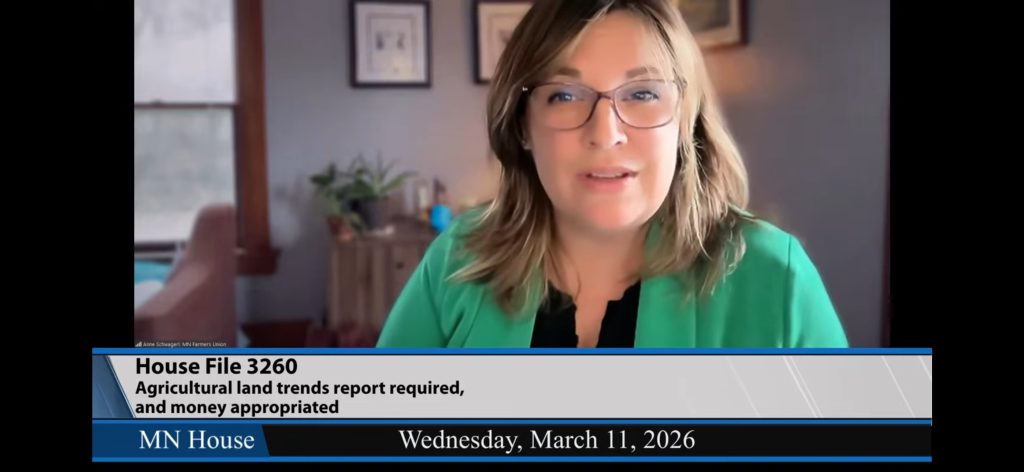
“Land is the foundation of agriculture,” said MFU Vice President Anne Schwagerl. “If we want the next generation of farmers to have a real chance to get started and stay in farming, we need to understand the pressures shaping farmland ownership today.”
Schwagerl testifies in support of Land Trends Report
MFU’s Vice President Anne Schwagerl also testified this week. Joining the Minnesota House Agriculture Committee, she shared MFU’s support support of Rep. Luke Frederick’s (DFL-Mankato) bill (HF3260), which would fund an Agricultural Land Trends Report to better understand changes in farmland ownership across the state.
Schwagerl farms near Browns Valley in Big Stone County in west-central Minnesota, where she and her family operate a diversified farm raising corn, soybeans, wheat, rye, and winter camelina.
In her testimony, Schwagerl described how the high cost of farmland was one of the biggest challenges she and her husband faced when they were starting out and transitioning into the family farm. Finding land they could afford—enough to support another family on the operation—was difficult then and remains a challenge today.
“Our farms don’t come with a retirement plan,” Schwagerl shared. “The promise of agriculture, for many family farmers including my own, is that over time we can build some equity and economic security through owning the land that we farm.”
Schwagerl emphasized that land ownership is central to the long-term stability of family farms. For many farmers, building equity through land is one of the few ways to create financial security in an industry that rarely offers traditional retirement options.
She also raised concerns about increasing competition for farmland from investors, sharing that while she understands competing with neighbors, the dynamic changes when pricing pressure comes from investors. She told committee members about social media advertisements promoting farmland as an investment opportunity that is “better than the stock market.”
“Land is the foundation of agriculture,” Schwagerl said in closing. “If we want the next generation of farmers to have a real chance to get started and stay in farming, we need to understand the pressures shaping farmland ownership today.”
Supporting expanded veterinary care
Finally, MFU outreach staff member Brittney Johnson testified before the Senate Agriculture Committee in support of Sen. Robert Kupec’s bill (SF4069) to clarify veterinary technician’s ability to provide basic on-farm veterinary services for large animals.
“Some cattle producers have veterinarians traveling from over two hours away,” Johnson shared. “A good friend of mine had to sell her horses because our local equine veterinarian doesn’t have the capacity for new patients.”
“Some cattle producers have veterinarians traveling from over two hours away,” Brittney Johnson told committee members.
Minnesota’s shortage of large animal veterinarians is making it harder for farmers to care for their livestock, which is why MFU is advocating for expanding training opportunities, funding scholarships, and otherwise increasing access to veterinary care.
As always, this is just a snapshot of our legislative work. If you have thoughts, questions, concerns or ideas, please reach out to Stu Lourey at stu@mfu.org or (320) 232-3047.