
Legislature Update: Shutdown has consequences
At midnight on Tuesday and with the start of October, current federal funding ran out after the president and Congress failed to reach a deal on spending. This has consequences first for federal employees, many of whom will go without pay or face the threat of layoffs.
According to reporting and agency plans, nearly half of USDA employees will be furloughed. While activities deemed critical will continue, farmer facing functions could be strained by significant layoffs at the Risk Management Agency (RMA), Farm Service Agency (FSA), and Natural Resource Conservation Service (NRCS).
Central to the fight in Washington over government funding are spiking healthcare costs. While Republicans control both the House and Senate and could make spending changes via reconciliation, they can’t pass a comprehensive budget without bipartisan votes. Congressional Democrats, including those in Minnesota’s congressional delegation are refusing to lend their votes to a package that does not renew enhanced tax credits that make healthcare affordable for middle income Minnesotans.
MFU President Gary Wertish joined state leaders to highlight the impact spiking healthcare costs would mean for farmers and others who purchase insurance on the individual market. Agency leaders released final rates for health insurance premiums showing steep cost increases a result in changes in Washington. In large part due to lack of enhanced tax credits, an average middle-income Minnesotan would see their costs increase an average of $2,000.
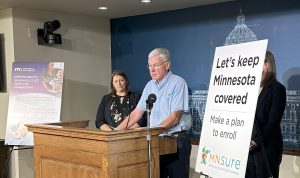
MFU President Gary Wertish at a press conference announcing health care insurance rates for 2026.
“I was asked here to help share some of what these rate increases will mean for our membership and family farmers more broadly,” said Wertish in a press conference with state leaders. “I’ll start with a short answer: it’s going to hurt them. It’s going to make life harder; it’s going to force tough, unnecessary decisions; and it’s going to add to the significant financial pressure already facing many of our members going into harvest.”
He pointed out the significant financial headwinds facing farmers beyond increasing healthcare costs.
“It’s hard to see a silver lining. But if there is one, it’s that Congress can still take action on healthcare. They need to extend the enhanced tax credits and help ward off the financial cliff facing down too many families. And they need to do it in short order and get the government back up and running.”
Later in the afternoon, Wertish joined leaders representing food shelves, counties, and others to tell a Minnesota Senate Subcommittee about the impact of federal cuts to food programs.
“We’re grateful and proud that Minnesota was a leader in establishing the first state funded LFPA program,” Wertish told the committee, referencing MFU’s work to establish a Local Food Purchasing Assistance program. “But as with so many other issues, the state spend is a fraction of what was funded on the federal level.”